The Star-Spangled Banner: America’s Best-Known Preindustrial Textile
By Jamie Eves • September 15, 2020
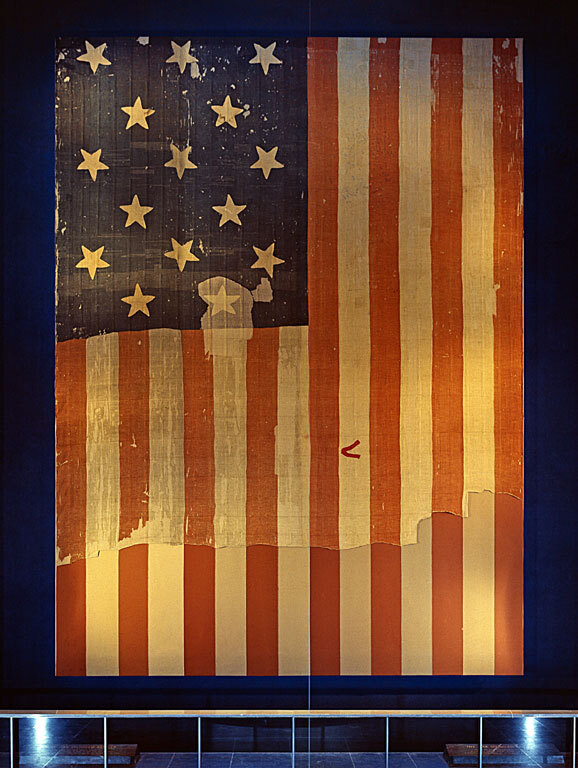
Hands down, the best-known preindustrial textile (defined as an article made
of woven, knitted, or felted cloth) that was produced in the United States and
is still in existence is the Star-Spangled Banner, the famous flag that flew over
Fort McHenry during the War of 1812, and which was immortalized in song by
Francis Scott Key. More than 12 million people have viewed the Star-Spangled
Banner in its display case at the Smithsonian Institution, with its 15 broad
stripes and 15 bright stars, and millions more have intoned its praises while
singing the American national anthem, “The Star-Spangled Banner.”
The Star-Spangled Banner is a preindustrial textile, which is to say that its
cloth and thread was all made by hand. It was sewn in the summer of 1813 by
Mary Young Pickersgill, a professional flagmaker who lived in Baltimore,
Maryland. She was hired by Major George Armistead, the commander of Fort
McHenry, a large, granite, star-shaped bastion that guarded the entrance to
Baltimore harbor. Charged with defending the city against a possible attack
from the sea, Armistead was expecting trouble. Just the year before, the
United States had declared war on Great Britain, and the War of 1812 was
underway. Baltimore was a likely target because it was the home port of many
of the American privateers that supplemented the United States’ undersized
Navy – privately owned ships carrying official letters of marque issued by the
American government that empowered them to engage in combat and seize
British ships as prizes of war. Therefore, in July, Armistead hired Pickersgill, a
29-year-old widow, to make two flags. One was to be a giant, 30 feet by 42
feet, capable of easily being seen by ships approaching Baltimore harbor from
Chesapeake Bay. Such huge flags, flown from tall poles, were not unusual. In
an age before lighthouses, they served during daylight as guideposts to ships
at sea seeking harbors. Armistead also ordered a second, smaller flag, 17 feet
by 25 feet. The second flag was a “storm flag,” to be flown during storms, to
preserve the larger, more expensive flag from being damaged. Armistead
boasted that, if the British intended to attack Baltimore, he wanted them to be
able to find it. He authorized that Pickersgill be paid $405.90 for the large flag
– the Star-Spangled Banner – and $168.54 for the storm flag.